

























Iranian cryptocurrency exchanges are experiencing a significant rise in outflows, as more citizens turn to digital assets to move wealth abroad. Amid crippling U.S. sanctions, high inflation, and government crackdowns, crypto is becoming an essential financial escape route for individuals and businesses alike.
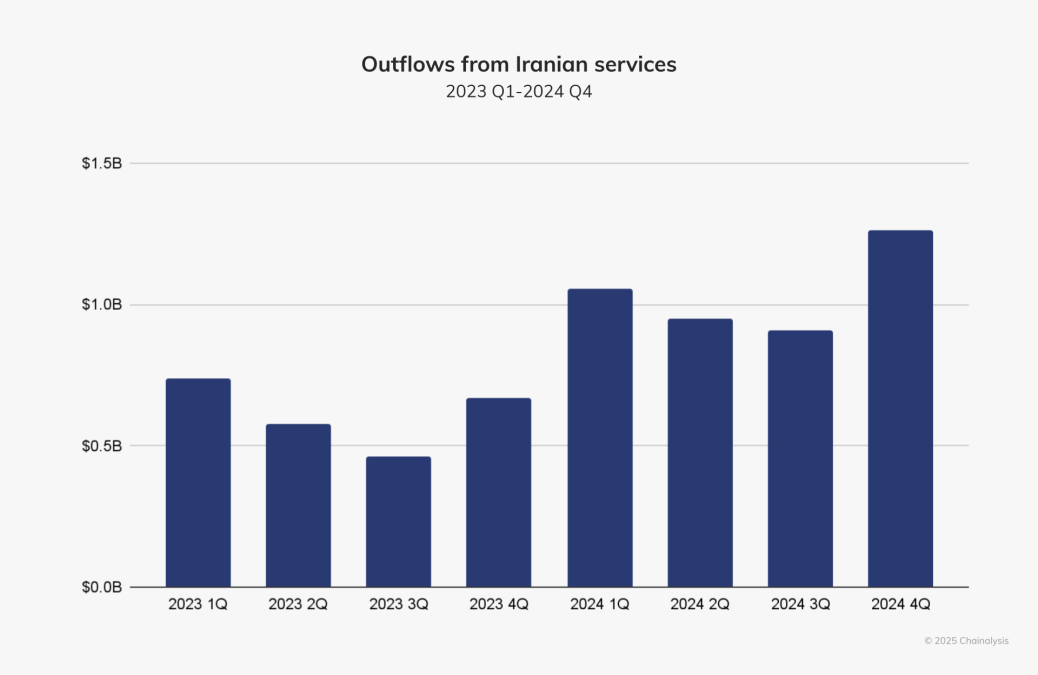
According to recent reports, crypto outflows from Iran soared to $4.18 billion in 2024, marking a 70% increase year-over-year. As the Iranian rial (IRR) continues to depreciate—losing 90% of its value since 2018—crypto adoption is accelerating. However, this growing trend of capital flight is also prompting stricter government controls, making Iran’s position on cryptocurrency increasingly complex.
Why Are Crypto Outflows Increasing in Iran?
Iran’s economy has been under severe strain for years, exacerbated by U.S. sanctions, internal political instability, and regional conflicts. The inability to access the global banking system has forced many Iranians to seek alternative financial tools.
Several factors are driving the rise in crypto-based capital flight:
1. Economic Instability and Inflation
- Inflation in Iran currently hovers between 40-50%, devaluing savings and reducing purchasing power.
- Since the U.S. withdrew from the JCPOA (Iran Nuclear Deal) in 2018, the rial has lost 90% of its value.
- The government’s restrictive monetary policies have further limited access to foreign currencies.
2. Sanctions and Global Financial Restrictions
- Since the 1979 U.S. Embassy seizure, Iran has faced heavy financial sanctions that cut it off from international banking systems.
- In February 2025, the U.S. administration reintroduced “maximum pressure” sanctions, intensifying financial isolation.
- Iran remains one of the three countries on the FATF blacklist, alongside North Korea and Myanmar, for weak anti-money laundering (AML) controls.
3. Geopolitical Tensions and Crisis-Driven Crypto Adoption
- Crypto outflows spike during geopolitical flashpoints, such as missile exchanges between Iran and Israel.
- Google Trends data shows global search interest for “Iran Israel” surging on April 14 and October 1, 2024—correlating with increased Bitcoin transactions.
- Bitcoin (BTC) remains the preferred asset, given its borderless nature and store-of-value properties during crises.
For many Iranians, cryptocurrency represents financial freedom, enabling them to move money beyond government controls.
How Is Iran’s Government Responding?
While Iran has historically been open to cryptocurrency—particularly as a Bitcoin mining hub—the increasing trend of capital flight is prompting tighter regulations and crackdowns.
Crackdown on Domestic Crypto Exchanges
- In December 2024, the government halted withdrawals from Iranian exchanges to curb outflows.
- Authorities imposed stricter surveillance on local trading platforms, forcing many Iranians to seek offshore alternatives.
Top offshore exchanges for Iranians:




State-Sponsored Crypto Strategies
- Iran continues to explore crypto-based international payments to bypass sanctions.
- The country supports Russia’s pro-crypto initiatives within BRICS, advocating for crypto use in cross-border trade.
However, while the government embraces crypto for economic resilience, it is increasingly wary of private citizens using it to evade capital controls.
Iran’s Growing Crypto Adoption: Key Statistics
Despite regulatory crackdowns, crypto adoption in Iran is expanding rapidly. According to Statista, the number of cryptocurrency users in Iran is expected to reach 3.89 million by 2025, with a 4.31% penetration rate.
Key Adoption Trends
- Bitcoin dominates Iranian crypto markets, often traded in peer-to-peer (P2P) transactions to bypass restrictions.
- Stablecoin usage is rising, providing a hedge against rial volatility.
- Younger generations are leading the shift, using VPNs and decentralized exchanges (DEXs) to trade freely.
With crypto adoption accelerating, Iran’s government faces a critical challenge: how to regulate without driving more citizens toward underground markets.
The Future of Crypto in Iran: Challenges and Opportunities
Iran’s relationship with cryptocurrency remains complex, balancing state-driven crypto strategies with concerns over financial outflows.
Challenges
- Government Crackdowns: Regulatory restrictions could push more users into the shadow crypto economy.
- Sanctions Pressure: The U.S. and its allies continue to monitor and enforce crypto compliance measures.
- Banking Barriers: Without access to international banking, crypto remains one of the few viable alternatives.
Opportunities
- Decentralized Finance (DeFi): Iranians are increasingly leveraging DeFi platforms to store and transfer wealth.
- Cross-Border Payments: Crypto could help businesses engage in sanctions-proof trade with countries like Russia and China.
- Financial Inclusion: Despite risks, crypto provides a lifeline for ordinary citizens facing economic hardship.
Conclusion: Will Crypto Remain Iran’s Financial Lifeline?
Iran’s cryptocurrency market is at a crossroads. As economic instability, sanctions, and political tensions escalate, crypto remains one of the few financial escape routes for millions of Iranians.
However, government crackdowns, rising compliance measures, and international pressure could limit access, forcing crypto users to adopt increasingly decentralized strategies.
