

























Article update on June 24, 2026: In subsequent news1, WhiteBIT announced their WhiteBIT EU platform obtained a MiCA license in Austria. It’s currently unclear what licensing or authorization has been granted in Croatia.
Europe’s crypto sector is entering a more disciplined era, and WhiteBIT is moving early to claim ground. Through its infrastructure arm White Tech, the group has secured a MiCA license in Croatia, opening the door to regulated operations across the European Union. The timing matters, since companies now face a hard compliance deadline on July 1st, and those who act first gain both credibility and market access.
Croatia Grants MiCA Approval to WhiteBIT
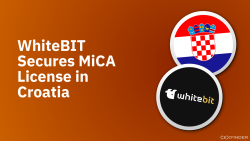
On April 23, 20262, the Croatian Financial Services Supervisory Agency (HANFA) granted White Tech3 authorization as a crypto-asset service provider under MiCA. This approval effectively extends WhiteBIT’s reach into a fully regulated EU framework, allowing the group to scale operations with legal certainty.
The license places White Tech under strict supervision, which includes governance standards, risk management protocols, and safeguards for client assets. While that may sound restrictive, it actually works in WhiteBIT’s favor. Regulation now acts as a trust signal in a market that has long struggled with credibility issues.
White Tech is only the second company in Croatia to receive such approval, and the first major global crypto exchange. That early positioning gives WhiteBIT a practical advantage as competitors scramble to meet the same requirements before the July 2026 deadline.
Expanding Core Crypto Services Across the EU
With the license secured, White Tech can now deliver a full range of services that directly support WhiteBIT’s broader ecosystem. The company handles key infrastructure functions, including crypto-to-fiat exchange, crypto-to-crypto trading, asset transfers, and custody solutions.
This structure allows WhiteBIT to operate more efficiently across jurisdictions. Instead of relying on fragmented service providers, the group builds its own regulated backbone. As a result, both retail users and institutional clients benefit from smoother transactions and tighter integration between traditional finance and digital assets.
In practical terms, this means you can expect faster conversions, more secure storage, and clearer compliance standards when interacting with services tied to WhiteBIT’s network.
MiCA Regulation Reshapes Europe’s Crypto Market
The MiCA framework introduces a single set of rules across all EU member states. That consistency removes much of the uncertainty that once defined the crypto industry in Europe.
For WhiteBIT, early compliance is more than simply meeting legal requirements. It’s a critical move that strengthens its reputation and positions the company as a serious long-term player. Firms without MiCA risk losing access to the EU market entirely after July 1, 2026.
From a user perspective, the benefits are clear. You get stronger protections, more transparency, and a better-defined legal environment. These changes make it easier to trust platforms operating under MiCA.
Leadership, Investment, and Long-Term Strategy
WhiteBIT’s expansion is closely tied to its founder, Volodymyr Nosov, whose influence continues to shape the group’s growth strategy. With reported wealth in the billions, Nosov has pushed for aggressive expansion into regulated markets, and Croatia now plays a central role in that plan.
White Tech, local company established in Croatia in 2023, serves as a key operational hub. Leadership has indicated that more business activities will flow through the country, which could lead to job creation and increased investment. There are also early signals of sports sponsorship initiatives, particularly in Hajduk football club4, although details remain limited.
This combination of capital, infrastructure, and regulatory alignment gives WhiteBIT a solid base for further European growth.
Why Is MiCA Regulated Important in Europe
If you are considering entering the crypto market, regulation now plays a central role in your decision. Platforms like WhiteBIT that are operating under MiCA standards offer a more secure and transparent environment.
You can look for licensed providers, verify their regulatory status, and engage with services that meet EU-wide requirements. This reduces risk and improves overall confidence in digital asset transactions.
WhiteBIT’s latest move shows how the industry is changing. The focus is shifting from rapid growth at any cost to structured expansion backed by compliance. That shift may not sound exciting at first, but it builds a stronger foundation for long-term adoption.
Top MiCA-regulated exchanges:


Additionally, WhiteBIT, Coinbase, Crypto.com, and Kraken have obtained MiCA licenses.
Some of these exchanges have additional licenses in one or more EU countries. For instance, Coinbase holds a MiCA license in Luxembourg, but also separate licenses in Germany, Ireland, and Netherlands.
Many other exchanges hold various licenses across the EU, which are listed in our reviews and the Regulated Exchanges page. For example:
- Gate holds a Malta MiCA and Cyprus CIF licenses (both passported to entire EEA region), but also separate licenses in Lithuania and Italy.
- Binance, world's biggest exchange, has licenses in France, Italy, Lithuania, Spain, and Poland.
A Strategic Move That Signals the Next Phase of Growth
WhiteBIT’s expansion through White Tech is potentially the most important licensing update for the company. As the MiCA deadline approaches, the gap between prepared companies and late adopters will widen. WhiteBIT has already placed itself on the right side of that divide, and users in EU can rest knowing they can continue to use the exchange without restrictions.
- https://blog.whitebit.com/en/whitebit-eu-secures-mica-license/ ↩︎
- https://www.hanfa.hr/vijesti/sjednica-upravnog-vijeca-hanfe-white-tech-dobio-odobrenje-za-rad-u-skladu-s-uredbom-mica/ ↩︎
- https://blog.whitebit.com/en/w-group-advances-european-expansion-as-white-tech-obtains-mica-authorization/ ↩︎
- https://www.index.hr/vijesti/clanak/tvrtka-ukrajinskog-milijardera-dobila-dozvolu-za-rad-u-hrvatskoj/2785049.aspx ↩︎