



























The cryptocurrency exchange industry just suffered another major blow. CoinEx has announced1 that it will permanently cease operations, becoming the latest established exchange to exit the market after a prolonged downturn in trading activity.
The exchange published its shutdown announcement on September 14, 2026, officially citing the extended cryptocurrency market downturn, falling industry trading volumes and liquidity, rising regulatory requirements, higher compliance costs, and growing operational uncertainty. CoinEx will begin winding down services on September 15, with withdrawals remaining available until December 22, 2026.
The decision comes shortly after other exchanges, including BitMart and BitMEX, also announced shutdowns. However, CoinEx’s situation appears materially different from BitMart’s current problems.
While CoinEx says customer assets remain fully backed and withdrawals will continue during the wind-down, BitMart customers have reportedly faced serious withdrawal problems, with some funds apparently unaccounted for.
CoinEx Announces Complete Exchange Shutdown
CoinEx says it reached the decision after assessing the difficult market conditions and the cost of continuing operations.
The exchange specifically pointed to three major pressures: lower cryptocurrency trading volumes and liquidity, increasing regulatory requirements, and rising compliance and operational costs. According to CoinEx, those factors have exceeded what it considers reasonable operating boundaries.
The exchange launched on December 22, 2017, meaning its planned closure will come almost exactly nine years after its launch. CoinEx says it grew from a small engineering team into a global exchange serving tens of millions of users.
Now, however, the company appears to have concluded that continuing the exchange business no longer makes financial or operational sense.
CoinEx Shutdown Timeline: Key Dates for Traders
CoinEx will shut down its services in several stages rather than stopping everything at once.
- Starting September 15, 2026, CoinEx will stop accepting new registrations. Futures markets will enter Reduce-Only Mode, while new orders and subscriptions for fiat services, margin trading, loans, Earn, staking, and strategic trading will also stop.
- The next major deadline arrives on September 22. At that point, CoinEx will cease all non-spot services and stop on-chain deposits, apart from CET deposits, which remain available until September 29. Futures positions still open on September 22 may be forcibly settled using the applicable index price.
- Then, on September 29, spot trading will end. CoinEx will also begin processing remaining non-USDT assets. Assets with sufficient external-market liquidity may be sold and converted into USDT, while assets without external liquidity may be delisted and no longer supported.
Finally, withdrawals will end at 02:00 UTC on December 22, 2026, bringing the exchange platform’s operations to an end.
CoinEx Shutdown Timeline
| Date | What happens |
|---|---|
| September 15, 2026 | New registrations stop; futures enter Reduce-Only Mode |
| September 22, 2026 | Non-spot services and on-chain deposits cease |
| September 29, 2026 | Spot trading ends; non-USDT assets begin disposal |
| December 22, 2026 | Withdrawals end and CoinEx exchange operations cease |
The announcement advises customers to withdraw assets as early as possible rather than waiting until the final deadline.
CoinEx Says Customer Funds Remain Fully Backed
The most important difference between CoinEx and some other recent exchange shutdowns concerns customer withdrawals. CoinEx explicitly states that its asset reserve ratio exceeds 100% and that all user assets are fully backed and available for withdrawal. The exchange says withdrawals will continue throughout the wind-down period.
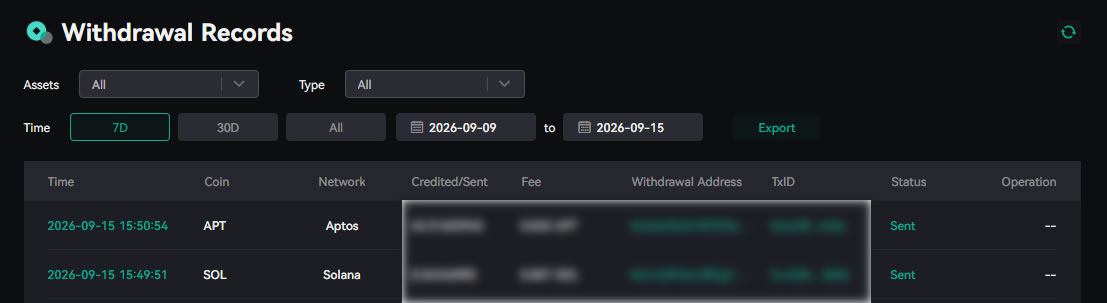
Our team tested withdrawals after the shutdown announcement, and everything got processed within minutes and without issues, so it doesn’t appear users have anything to worry about.
That does not mean customers should wait. CoinEx warns that blockchain congestion, changing transaction fees and longer confirmation times could affect withdrawal processing. Customers should therefore move their assets well before December 22 and preferably before the September 29 asset-conversion deadline if they want to withdraw assets in their original form.
CoinEx also says that assets left after the withdrawal period will be transferred into independent custody. The company will charge a monthly custody fee equal to 5% of the original asset balance after the withdrawal period ends.
For customers holding funds on CoinEx, the message is simple: withdraw early and do not wait for the final deadline.
CoinEx Is Different From the BitMart Situation
CoinEx’s announcement comes at an awkward time for the exchange industry because BitMart is already facing a much more troubling shutdown process. BitMart announced its own complete shutdown in July, initially saying that trading would end on August 26 and platform operations would terminate in January 2027. The decision surprised the industry because BitMart had continued expanding its products and regulatory footprint shortly before the announcement.
The situation has since become significantly more concerning for BitMart customers. Recent updates indicate that very few withdrawals were processed after the initial shutdown announcement, while subsequent withdrawal attempts reportedly returned funds to customer accounts without completing on-chain transfers. Customer support has also reportedly been unresponsive.
BitMart has appointed Alvarez & Marsal as a financial adviser to help assess its financial position. The available information has raised concerns that the exchange may not have enough funds to cover all customer withdrawals, although the exact situation remains unresolved. BitMart founder Sheldon has denied that funds were misappropriated, saying the core team is conducting an inventory and asset consolidation process.
On the other hand, CoinEx says customer funds are fully backed and continues to process withdrawals as part of an orderly shutdown. BitMart, by contrast, appears to be struggling to process customer withdrawals and has faced questions over whether all customer assets are accounted for.
The two shutdowns therefore should not be treated as the same type of event.
Why Is CoinEx Shutting Down?
CoinEx has been relatively direct about the broad reasons behind its decision. The company cited the prolonged crypto bear market, declining industry trading volumes and liquidity, rising regulatory requirements, compliance costs, and operational uncertainty.
But reading between the lines, the prolonged market downturn is likely the most important factor. Centralized exchanges make much of their revenue from trading activity. When trading volumes fall, exchanges have fewer opportunities to generate transaction fees. At the same time, many operating expenses do not fall at the same rate.
An exchange still needs engineers, security teams, compliance departments, customer support, legal staff, infrastructure and liquidity arrangements. Regulatory expansion can also add licensing, reporting, monitoring and compliance expenses.
For a large global exchange, those costs may remain manageable. But for a medium-sized exchange, the equation can become much harder. In the end, crypto exchanges are businesses, and it always comes down to money.
The Medium-Sized Exchange Problem
BitMart and CoinEx’s closure may just be the start of a particularly difficult period for mid-sized cryptocurrency exchanges. Just like BitMart, CoinEx was not a tiny exchange with negligible activity. It had established itself as a global centralized trading platform and remained around the top 35 exchanges by trading volume, depending on the period and ranking methodology.
Yet even that level of activity may no longer be enough. The exchange industry has become increasingly expensive to operate. At the same time, competition remains intense, with the largest platforms controlling substantial liquidity and attracting traders through deeper markets, broader product offerings and stronger brands.
That creates a difficult position for medium-sized exchanges. They face many of the same regulatory and infrastructure costs as larger competitors, but they lack the enormous trading volumes needed to spread those costs across a much larger customer base.
The current market may therefore be creating a squeeze from both sides. Trading revenue is falling while the cost of operating a compliant global exchange continues to rise.
BitMEX and BitMart Show the Same Pressure in Different Ways
As mentioned, CoinEx is not the only exchange to disappear during this difficult period. BitMEX recently announced its own shutdown, although its closure was less surprising given its relatively limited trading activity compared with the industry’s largest exchanges.
BitMart’s case attracted considerably more attention. This platform operated for more than eight years and reportedly accumulated more than 12 million registered users. It also maintained respectable spot and derivatives volumes while continuing to expand into areas such as TradFi, prediction markets, lending and crypto payment cards. The exchange even announced an Australian Financial Services License shortly before its shutdown.
BitMart has announced it will permanently shut down its cryptocurrency exchange, with trading services ending in August 2026 and full platform operations ceasing on January 31, 2027. The unexpected decision follows months of expansion, new products, and regulatory approvals, leaving the reasons for the closure unclear.Read Now
That made the closure particularly difficult to understand. BitMart continued releasing product updates and other announcements almost until the shutdown, giving customers little public warning that the entire platform was about to disappear. The subsequent withdrawal problems have added another layer of uncertainty.
Could More Crypto Exchanges Shut Down Soon?
CoinEx’s decision raises an uncomfortable question for the rest of the industry: could more exchanges follow? There is no evidence that a specific exchange is preparing to close, and it would be irresponsible to predict individual shutdowns without evidence. However, the broader conditions create a clear risk.
If trading volumes remain depressed for an extended period, medium-sized exchanges may struggle to justify the cost of maintaining global operations. Regulatory requirements can add further pressure, particularly for exchanges serving customers across multiple jurisdictions. CoinEx did not obtain a MiCA license and stopped servicing EU users just two months ago in July 2026, which may have attributed to its downfall.
The current wave of closures could therefore continue if market activity does not recover. CoinEx itself may provide an important signal. If an exchange with an established global customer base and meaningful trading activity decides that the current environment is no longer sustainable, smaller competitors may face an even tougher calculation. The inability to (legally) serve European customers without MiCA licensing may be the final nail in the coffin for other platforms as well.
No-KYC Platforms Appear to Be Holding Up Better
Interestingly, the current pressure does not appear to affect every part of the exchange industry equally. Most no-KYC and lightly regulated offshore platforms appear to be operating normally for now. Their lower compliance costs can give them an advantage when trading volumes fall.
These platforms generally operate with fewer regulatory obligations than exchanges seeking licenses across major markets. That can reduce staffing and compliance expenses, although it also creates greater regulatory and counterparty risks for customers.
By contrast, regulated exchanges must spend heavily on licensing, transaction monitoring, sanctions screening, customer verification, reporting and other controls. That creates an unusual market dynamic. The exchanges facing the greatest regulatory costs may also be the exchanges least able to absorb those costs when trading volumes decline.
The result could be further consolidation around the largest exchanges, while some medium-sized platforms either reduce their geographic footprint or exit the market entirely.
Exchange Shutdowns Could Signal a Longer Bear Market
Perhaps the most interesting part of CoinEx’s decision is what it says about expectations for the crypto market. And the picture this paints is grim.
Exchange operators have better visibility into their own trading activity than most outside observers. If an established exchange decides to close rather than continue operating through the downturn, management may believe that a meaningful recovery in trading volumes is not coming soon enough to justify continued expenses.
That doesn’t necessarily mean a bull market cannot begin next month. Crypto markets can change quickly, and trading volumes can surge during periods of strong price momentum. However, CoinEx’s decision suggests that the company was unwilling to continue absorbing today’s costs while waiting for that recovery.
BitMart’s closure raises similar questions, although the uncertainty surrounding its customer funds makes the situation considerably different. Together with the recent BitMEX shutdown, the events point to a broader industry reset.
CoinEx Shutdown Leaves Customers With a Clear Exit Path
For CoinEx customers, the situation is considerably clearer than the problems currently surrounding BitMart. CoinEx has published a detailed timetable, says its reserves exceed 100%, and has confirmed that withdrawals will remain available until December 22, 2026.
Customers should still act early, and anyone holding assets on CoinEx can begin withdrawing them now. Those who want to retain their assets in their original form should complete withdrawals before 02:00 UTC on September 29, when CoinEx begins processing remaining non-USDT assets.
Customers should also avoid relying on social media messages promising special withdrawal arrangements. CoinEx warns that it will never request private keys, passwords or verification codes, or ask customers to send assets to an address to unlock funds.
Another Major Warning Sign for the Crypto Exchange Industry
CoinEx’s shutdown marks another difficult chapter for centralized crypto exchanges. The company is not blaming a security breach or a failure to cover customer assets. Instead, it points directly to the combination of weak market activity, declining liquidity, higher regulatory costs and operational uncertainty. That explanation also fits the broader pattern emerging across the industry.
BitMEX and BitMart have already announced closures, while BitMart’s subsequent withdrawal problems have created additional concerns about exchange solvency and customer protection. CoinEx currently presents a different picture, with the company stating that customer assets remain fully backed and withdrawals continue normally through the shutdown period.
At Cexfinder, we actually loved using CoinEx. The exchange had numerous features, nearly 1,000 altcoins, decent liquidity, good selection of fiat deposit options, and cheap fees, among other perks. In fact, we considered it one of the best mid-sized alternate trading platforms, comparable to some of the industry’s biggest exchanges in terms of features. In short, it will be missed.
The bigger question is what comes next. If the bear market continues and trading volumes remain low, more medium-sized exchanges could find themselves facing the same calculation. Regulatory compliance may be sustainable during a bull market with strong fee revenue, but it becomes much harder to justify when customers trade less and liquidity dries up.
For now, CoinEx customers have a clear path forward: withdraw assets early, close open positions, and avoid waiting until the final deadline. For users impacted by CoinEx shutdown, our website still offers plenty of alternative exchanges in any category.
For the wider crypto industry, however, the shutdown may be a warning that the current bear market is proving more durable than many exchange operators expected.
- Important Notice on CoinEx’s Orderly Cessation of Operations: https://www.coinex.com/en/announcements/detail/53539656293908 (September 14, 2026) ↩︎


