





















Bitunix has announced two of its biggest product launches this year (so far), introducing a full CFD trading platform and the Bitunix Card, a Visa-powered payment card designed to let users spend USDT on everyday purchases. The additions represent a major expansion beyond the exchange’s traditional crypto focus.
Until now, Bitunix offered only spot trading for gold among traditional assets, while its futures platform included a relatively modest selection of stocks, indices, metals, and commodities. The new CFD platform dramatically expands that offering, giving users access to hundreds of traditional financial instruments through a dedicated trading interface.
At the same time, the Bitunix Card extends the platform beyond trading by allowing users to use their crypto balances for payments at Visa merchants around the world.
Bitunix Launches Native CFD Trading
The newly announced1 CFD platform allows traders to speculate on price movements without purchasing the underlying assets. CFDs, or Contracts for Difference, enable users to profit from rising or falling markets while trading with leverage, making them a popular product among active traders.

CFD and perpetual futures trading both enable speculation on crypto prices without owning the asset, but they differ in contract nature, margin requirements, and costs. CFDs involve spread and financing charges, while perpetual futures use funding rates and have exchange-set margins.Read Now
Unlike many CFD brokers that rely on third-party software such as MetaTrader 5, Bitunix has integrated the entire experience directly into its own platform. Users can browse traditional markets from the same interface they already use for crypto trading, eliminating the need to switch between applications.
Trading takes place through a dedicated CFD account funded with USDX. Most products settle in USD, while leverage is automatically adjusted according to Bitunix’s margin tiers. The platform also follows the trading sessions of each underlying market, meaning products such as stocks and indices are available only during their respective market hours.
Available Assets
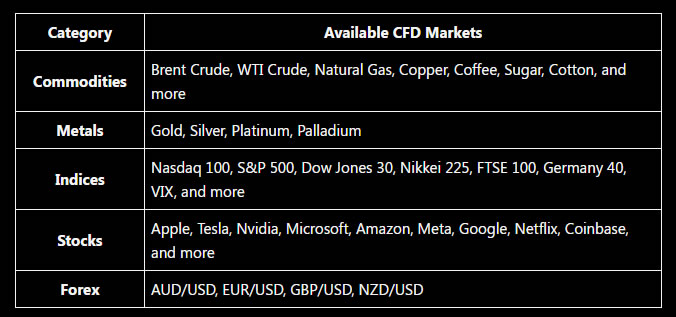
The initial launch covers a broad selection of asset classes. Commodity CFDs include Brent crude oil, WTI crude oil, natural gas, copper, coffee, sugar, cotton, and several other raw materials. Precious metals include gold, silver, platinum, and palladium. Equity index products cover benchmarks such as the Nasdaq 100, S&P 500, Dow Jones Industrial Average, FTSE 100, Nikkei 225, Germany 40, and the VIX volatility index.
Bitunix has also introduced stock CFDs on many of the world’s largest publicly traded companies, including Apple, Tesla, Nvidia, Microsoft, Amazon, Meta, Alphabet, Netflix, and Coinbase. Forex trading is available through major currency pairs including EUR/USD, GBP/USD, AUD/USD, and NZD/USD.
The exchange said traders will have access to professional charting tools, live bid and ask pricing, detailed contract information, and several order types including market, limit, trigger, take-profit, and stop-loss orders. Positions can be managed individually or grouped together, with options to batch close trades based on direction, profit, or loss. During the first phase of the rollout, Bitunix said CFD trading will use straight-through processing (STP) execution and will not charge trading fees.
The launch significantly expands Bitunix’s traditional finance offering. While the exchange previously provided limited exposure to traditional assets through gold on spot trading and a relatively small TradFi section within futures markets, the new CFD platform brings a much broader selection that more closely resembles offerings from larger CFD competitors including Bybit, Bitget, and PrimeXBT.
Bitunix Card Turns USDT Into a Payment Method
Alongside CFD trading, Bitunix has officially launched2 the Bitunix Card, giving eligible users a way to spend USDT directly instead of keeping it solely for trading or transfers.
The card operates on Visa’s global payment network, allowing payments at more than 130 million merchants worldwide. Users can shop online, pay in stores through supported digital wallets, book travel, pay subscription services, and make purchases anywhere Visa is accepted.
The launch currently includes only a virtual card, which becomes available immediately after approval. A physical Bitunix Card is planned for August and will add support for chip payments, contactless NFC transactions, and ATM withdrawals.
Applications3 are available through both the Bitunix website and mobile apps. Users must complete identity verification, provide residential information, and transfer at least 100 USDT into their Card Account before activation. Bitunix notes that this is not an activation fee, as the funds remain fully available for spending.
How Bitunix Card Works
Rather than converting crypto during each purchase, the Bitunix Card uses a dedicated Card Account. Users first transfer USDT from their Spot or Futures accounts into the Card Account. Bitunix automatically converts the balance into USD on a 1:1 basis, creating a spending balance that can be used for purchases.
When a transaction is made, Visa processes the payment while the merchant receives payment in its local currency. If the purchase is made outside the United States, Visa performs the currency conversion before the equivalent amount is deducted from the user’s USD balance.
Bitunix advises4 users travelling internationally to pay in local currencies whenever possible instead of accepting Dynamic Currency Conversion, which merchants sometimes offer. According to the exchange, paying in local currency generally results in better exchange rates because the conversion is handled through Visa rather than the merchant’s payment provider.
Wallet Support and Spending Options
Although the current product is virtual, the card supports a wide range of payment methods. Users can enter the card number for online purchases or add the card to Apple Pay and Google Pay for contactless payments. Support is also available for several regional payment services including Alipay, WeChat Pay, LINE Pay, GrabPay, PayPal, and Samsung Pay, depending on local availability and platform policies.
Bitunix says the virtual card can be used for e-commerce, software subscriptions, streaming services, travel bookings, food delivery platforms, and other online purchases wherever Visa is accepted.
Cashback Up To 8%
One of the card’s headline features is a cashback program5 that rewards eligible purchases with USDT. These cashback rates range from 1% to 8%, depending on the user’s VIP level or card spending tier. Rewards are paid directly in USDT once a transaction has settled, removing the need to redeem reward points or vouchers.
Users can also unlock higher cashback tiers by reaching monthly spending thresholds, even if their exchange VIP level remains unchanged. Once achieved, the higher cashback level remains active through the following calendar month.
Note: VIP 1 on Bitunix is easily achievable, only requiring $500 in account assets.
Not every transaction qualifies. Certain merchant categories are excluded, while purchases made in the European Economic Area and the United Kingdom are currently ineligible for cashback under the program’s terms.
Auto Earn Generates Yield With Idle Balances
Bitunix has also integrated an automatic yield feature into the card. Any USDT transferred into the Card Account is automatically enrolled in Auto Earn6 without requiring a separate subscription. Rewards begin accruing immediately and are calculated hourly before being credited back to the Card Account.
The first 200 USDT in the account earns a fixed annual percentage rate of up to 11.6%. Any balance above 200 USDT receives a floating APR that changes according to market conditions.
Unlike many yield products, Auto Earn does not lock funds. Users remain free to spend their balance at any time while continuing to earn rewards on eligible holdings.
Fees and Availability
Bitunix says the card has no issuance fee, annual fee, monthly maintenance fee, card cancellation fee, or crypto conversion fee7.
However, several transaction-related charges still apply. Purchases made in non-USD currencies incur a 1.5% foreign exchange markup on Visa’s exchange rate, while USD cross-border transactions carry a 0.5% fee. Transactions below the equivalent of $10 incur a 0.30 USDT service fee after the first three qualifying transactions each month.
The card currently supports spending limits of up to $10,000 per transaction and per day, with a monthly limit of $50,000 for standard Green Card users.
Availability is limited to exchange’s supported jurisdictions, but is also unavailable in additional regions8 and the European Economic Area because of legal and regulatory requirements. The physical card, expected to launch in August, will add ATM withdrawals with a daily withdrawal limit of $1,500 and monthly withdrawals of up to $15,000, subject to applicable fees.
Bitunix Card vs Other Crypto Cards
The crypto card market has become increasingly competitive, with nearly 20 major exchanges offering this service now. Bitunix enters a crowded field with a Visa card that combines zero issuance fees, automatic yield on idle balances, cashback of up to 8%, and support for more than 130 million merchants worldwide.
Compared with rivals, Bitunix focuses on reducing ongoing costs. The exchange charges no issuance fee, no annual fee, no monthly maintenance fee, and no crypto conversion fee. Users also earn up to 11.6% APR on eligible USDT held in their Card Account through Auto Earn, a feature that remains uncommon among exchange-issued payment cards. The main trade-off is that only a virtual card is available at launch, with the physical version scheduled for August. Sadly, the Bitunix card is unavailable in several regions, including the European Economic Area.
- Bybit Card remains one of the most polished crypto payment products, offering both virtual and physical cards in supported markets with no issuance or top-up fees. However, its availability is largely limited to the EEA and UK, while Bitunix currently targets a different group of supported jurisdictions.
- BitMart Card offers one of the broadest product lineups, including Virtual, Plastic, Metal Visa cards and a prepaid Mastercard. Availability is nearly global, although premium physical cards carry issuance fees and the prepaid Mastercard charges a top-up fee.
- WhiteBIT’s Nova card continues to rank among Europe’s strongest crypto cards, thanks to free virtual cards, a low-cost physical card, cashback of up to 10% in selected categories, and minimal foreign exchange costs. Like Bybit Card, however, it primarily serves European users.
- CoinW Card targets users who need exceptionally high spending limits and broad international coverage. The exchange charges for both virtual and physical cards and applies deposit fees, making it more expensive to start using than Bitunix.
| Card | Virtual | Physical | Issuance Fee | Top-up Fee | Cashback | Extra Features |
|---|---|---|---|---|---|---|
| Bitunix Card | Yes | Coming in August | Free | None | Up to 8% | Up to 11.6% APR Auto Earn |
| Bybit Card | Yes | Yes | Free | None | Promotional offers | Strong user experience |
| BitMart Card | Yes | Yes (Plastic & Metal) | Free Virtual, paid physical cards | None (Visa) | Varies | Multiple card options |
| WhiteBIT Nova | Yes | Yes | Free Virtual, €10 Physical | None | Up to 10% | Low forex fees |
| CoinW Card | Yes | Yes | $15 Virtual, 98 USDT Physical | Around 2% | Varies | High spending limits |
Binance, Kraken, OKX, Crypto.com, BloFin, BingX and several other exchanges also offer crypto payment cards. Many of these products remain limited by regional availability or more restrictive eligibility requirements, making direct comparisons dependent on where users live.
Despite the competition, Bitunix Card is one of the most cost-efficient ones on the market. Payment fees can be entirely negated by its generous cashback program, and no other fees or costs will eat into your holdings. The Auto-Earn availability can further increase your savings with zero effort.
Conclusion
With the launch of native CFD trading and the Bitunix Card, the exchange has taken a significant step beyond its roots as a crypto derivatives platform. The expanded CFD lineup gives traders access to hundreds of traditional financial instruments without leaving the Bitunix ecosystem, while the new Visa card allows users to spend USDT in everyday life and earn rewards on idle balances.
Although regional restrictions still limit card availability and only the virtual card is live for now, Bitunix has assembled a feature set that compares well with more established crypto card providers and positions the exchange as a broader financial platform rather than simply a cryptocurrency trading venue.
- Introducing Bitunix CFD Trading: https://support.bitunix.com/hc/en-us/articles/60099452280345-Introducing-Bitunix-CFD-Trading-A-New-Way-to-Access-Global-Markets ↩︎
- Introducing Bitunix Card: https://support.bitunix.com/hc/en-us/articles/60109719218713-Introducing-Bitunix-Card-A-Smarter-Way-to-Use-Your-USDT ↩︎
- How to Apply & Activate Bitunix Virtual Card: https://www.bitunix.com/hub/helpcenter/article/how-to-apply-bitunix-virtual-card?id=284 ↩︎
- How Bitunix Card Works: https://www.bitunix.com/hub/helpcenter/article/how-to-use-bitunix-card?id=269 ↩︎
- Introduction to Card Rewards: https://www.bitunix.com/hub/helpcenter/article/introduction-to-card-rewards?id=276 ↩︎
- How Auto Earn Works: https://www.bitunix.com/hub/helpcenter/article/how-auto-earn-works?id=273 ↩︎
- Bitunix Card Usage, Fees, & Limits: https://www.bitunix.com/hub/helpcenter/article/bitunix-card-fee-usage-limit?id=286 ↩︎
- Restricted Jurisdictions (card): https://www.bitunix.com/hub/helpcenter/article/bitunix-card-restricted-jurisdictions?id=282 ↩︎